Yetzirah 2026 Jewish Poetry Conference: Public Events, June 15-21, 2026

 NAVIGATION MENU:

CONFERENCE OVERVIEW (back to top)
Yetzirah’s fourth Jewish Poetry Conference, the only one of its kind in the world, will be held at the YMCA Blue Ridge Assembly, a full-service conference center nestled in the mountains, a five-minute drive from Black Mountain, twenty-five minutes east of Asheville. Surrounded by hiking trails and mountain streams, with a variety of welcoming indoor spaces, covered porches, and outdoor amphitheaters, we feel this might well be our strongest conference yet.

  • For participants admitted as Yotzer Fellows, the conference will run from Monday, June 15, through Sunday, June 21, 2026.
  • For participants in the Dayenu cohort, you can join us for the full length of the conference (June 15-21) or Tuesday morning, June 16-Friday, June 19).
  • Our time together will consist of a mix of generative workshops focused around Jewish questions and themes, discussion panels, craft talks, and faculty readings, as well as many shared meals and celebrations.

Our public events, consisting of panels, craft talks, and readings, and open to audience members of all traditions in-person and online, will take place Tuesday, June 16, through Friday, June 19. 

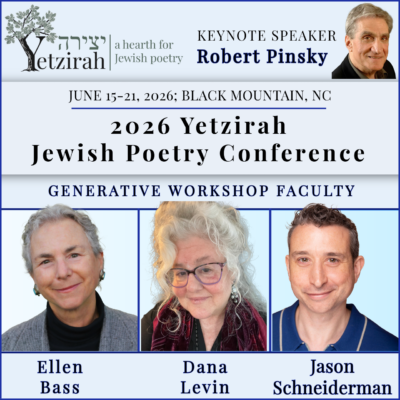
We are thrilled to welcome Keynote Speaker Robert Pinsky; workshop faculty Ellen Bass, Dana Levin, and Jason Schneiderman; on-campus Dayenu faculty Yehoshua November and Dan Rosenberg; online Dayenu faculty TBD; and manuscript faculty Carol Moldaw.

NOTES ON A NEW STRUCTURE FOR 2026 (back to top)
Since our first conference in 2023, it has been our aim to create a gathering that reflects our expansive mission of supporting Jewish poets and Jewish poetry, offering a conference that functions as an egalitarian community, supporting writers at all levels of their careers. Over the last three years, we’ve heard from participants and audience members alike about the inspiring, life-changing experiences they’ve had with us at these conferences. Yet we’ve also received feedback that the different levels of participant cohorts (Fellows, Scholars, and Contributors) has felt unnecessarily hierarchical and diminished many writers’ sense of communal belonging.

For our fourth year, in response to these consistent concerns and in an effort to create more inclusive opportunities aligned with our mission, we’ve evolved the structure of the 2026 Yetzirah Jewish Poetry Conference.

There will be five ways to join our expanded conference community, which you’ll find outlined below.

YOTZER FELLOWS (back to top)
For those who apply to attend workshops with Ellen Bass, Dana Levin, and Jason Schneiderman, we will have an admitted cohort of 36 writers consisting of a mix of emerging and established poets with no set tiers, with all given the title Yotzer Fellow. “Yotzer” is Hebrew for “creator,” and shares a root with Yetzirah, the World of Formation in Jewish mysticism. Their admittance will be evaluated on the strength of the poetry samples and application answers submitted, which will each be read by at least two people on either Yetzirah’s board or staff, with an aim to admit a diverse cohort of fellows at varying stages of their writing careers.

    • All admitted participants will be invited to submit brief proposals for a panel topic or craft talk, with final selections made by Yetzirah staff. Participants selected to give a talk or participate in a panel will receive a stipend of $200.
    • All admitted participants will be invited to opt in to be paired with a chavruta, a study partner, with whom to exchange work at the conference.
    • Yotzer Fellows who have published two or more full-length collections can put their name on a list of potential manuscript consultants. If they are selected by another participant for a consultation, for responding to five pages of poetry, they will receive a stipend of $150 per consultation.
    • All workshops will continue to be generative, allowing writers of different experience levels to share the same creative space.
    • While our evening readings will now feature our Keynote and faculty, there will be at least one open mic opportunity, with sign-ups available to Yotzer Fellows and our in-person Dayenu cohort.

Generative Workshops (for Yotzer Fellows)

Ellen Bass: Among Ellen Bass’s poetry collections are Indigo (Copper Canyon Press, 2020), Like a Beggar (Copper Canyon Press, 2014), The Human Line (Copper Canyon Press, 2007), and Mules of Love (BOA, 2002). Among her awards are fellowships from the Guggenheim Foundation, the National Endowment for the Arts, the Lambda Literary Award, the California Arts Council, and four Pushcart Prizes. Her poems appear regularly in the New Yorker, American Poetry Review, and many other journals. With Florence Howe, she coedited the first major anthology of women’s poetry, No More Masks! (Doubleday, 1973), and she coauthored the groundbreaking The Courage to Heal: A Guide for Survivors of Child Sexual Abuse (HarperCollins, 1988). A Chancellor Emerita of the Academy of American Poets, Bass founded poetry workshops at Salinas Valley State Prison and the Santa Cruz, CA jails, and teaches in Pacific University’s MFA program.

Praise Poems

“O tell us, poet, what you do? / – I praise./ But those dark, deadly, devastating ways,/ how do you bear them, suffer them?/ —I praise.”—Rainer Maria Rilke

Praise poems may arise from overflowing joy, but they can also be built from the hard labor of affirming what we treasure––even in the face of suffering and the inevitable transience of life. And if the ultimate reason to write poetry is to be changed, then the praise poem is one of the fundamental paths to that transformation. Some considerations: How do we praise in a world full of suffering? How do we use the craft to write sentiment without sentimentality? How do we acknowledge the shadow in every joy and the light even within sorrow? In this workshop, we’ll read praise poems from Jewish and non-Jewish writers, and you’ll develop your ability to write poems that celebrate the marvelous, exalt the humble, and reveal the beauty and mystery of life.

—————–

Dana Levin is the author of five books of poetry. Her latest is Now Do You Know Where You Are (Copper Canyon), a 2022 New York Times Notable Book and NPR “Book We Love.” Other books include Banana Palace (2016) and Sky Burial (2011), which The New Yorker called “utterly her own and utterly riveting.” Her first book of essays is due out from Graywolf Press in 2027. Levin is a grateful recipient of many honors, including those from the National Endowment for the Arts, PEN, and the Library of Congress, as well as from the Rona Jaffe, Whiting, and Guggenheim Foundations. With Adele Elise Williams, she co-edited Bert Meyers: On the Life and Work of an American Master (2023) for the Unsung Masters Series. Levin teaches for the Bennington Writing Seminars, the MFA program at Bennington College, and serves as Distinguished Writer in Residence at Maryville University in St. Louis.

It’s a Miracle!
The parting of the Red Sea. Manna from heaven. Water from the rock. Sarah conceives! The story of the Jews is a story brimming with miracles. In this generative workshop we will discuss the miraculous in Jewish life, our writing lives, and our psyches. We will engage in writing exercises meant to invite the miraculous into our art. Along the way, we will look at poems by Bert Meyers, Louise Glück, and others to consider how poets invite the unexpected, transformative, and revelatory into their works.

—————–

Jason Schneiderman is the author of five poetry collections, most recently Self Portrait of Icarus as a Country on Fire (Red Hen, 2024); an essay collection Nothingism: Poetry at the End of Print Culture (University of Michigan Press, Poets on Poetry 2025); a prosody manual Teaching Writing Through Poetry: An Introduction to Poetic Form (Bloomsbury 2025); and he edited the single topic reader Queer: A Reader for Writers (Oxford University Press 2016). His poems and essays have appeared in numerous journals and anthologies, including The Penguin Book of the Sonnet, and three installments of Best American Poetry. His awards include the Emily Dickinson Award from the Poetry Society of America, the Jerome J. Shestack Award from The American Poetry Review, and a Fulbright Fellowship from the Fulbright Foundation. He is longtime co-host of the podcast Painted Bride Quarterly Slush Pile and has been a guest host for The Slowdown. He is Professor of English at the Borough of Manhattan Community College and teaches in the MFA Program for Writers at Warren Wilson College.

Purple Fire
In Judaism, writing is a sacred practice and reading is a way of life; we are the people of the book, after all. In this workshop, we will adapt ideas of the textual as they relate to the sacred, to generate poems that fulfill our contemporary needs while respecting traditional practice. We will consider midrashim about the alphabet, the practices of the Sofer/Soferet, and stories about text in Jewish life and history. The torah is said to be black fire (ink) on white fire (parchment), and I’ve named this workshop “Purple Fire” because I write with purple ink, and I hope that this title encourages you to find your way into Jewish traditions that engage your own poetic practice.

Yotzer Fellows: Fees & Funding

  • Tuition ($800)
  • Room & board, which covers breakfasts and lunches, a shared welcome dinner, and a shared Shabbat dinner:
    • Total: $800, with a single room.
    • Total: $500, with a double room.
  • Total Cost:
    • $1,600, with a single room.
    • $1,300, with a double room.
  • Drawing on annual donations and conference-specific gifts from anonymous donors,  we will have $18,000 of need-based funds available, with up to $500 for each participant based in the U.S. and up to $1,000 for participants traveling from abroad. The individual amounts will be based on how many accepted participants apply for funding.
    • Our thanks to the generous anonymous donors who created these funds:
      • The Miles and Mimi Coon Scholarship Fund
      • The Bill & Gloria Goodman Scholarship Fund
      • The Chesed Scholarship Fund (for caretakers, parents of young children, & those financially hindered due to medical needs)
  • Participants selected to give a talk or participate in a panel will receive a stipend of $200.
  • Participants selected by other participants for manuscript consultations will receive a stipend of $150 per consultation.

    DAYENU COHORT (IN-PERSON) (back to top)
    While our 36 Yotzer Fellows are wonderfuldayenu!we welcome writers of all traditions and all levels of experience (including those interested in trying out writing for the first time) to join us as part of the Dayenu Cohort.

    We’re doing this to expand the richness of our conference community and, in turn, have some special opportunities to help ensure that Dayenu  participants feel just as inspired as our Yotzer Fellows. The Dayenu application is simple, consisting of personal information, a brief statement about your reasons for joining Yetzirah’s conference cohort, and details about Yetzirah’s policies of welcome and inclusivity. Dayenu registration includes:

    • Three generative morning workshops with past Conference Fellows Yehoshua November and Dan Rosenberg, with the possible addition of a third faculty member based on demand.
    • An all-events pass to join us for our conference events including public talks and readings, private evening social events, and Shabbat services on Friday and Saturday morning.
    • Dayenu Cohort participants will be listed along with Yotzer Fellows in our conference archive.
    • An invitation to be paired with a chavruta, a study partner, from the Dayenu Cohort with whom to exchange work at the conference.
    • An invitation to join us at our welcome dinner on Monday, June 15.
    • An option to join us for Shabbat dinner on Friday, June 19.
    • We will have discounted blocks of rooms available at a hotel near campus available for Dayenu participants.

    Dayenu workshop descriptions will be forthcoming this spring.

    Yehoshua November is the author of three poetry collections: God’s Optimism, a finalist for the L.A. Times Book Prize; Two Worlds Exist, a finalist for the National Jewish Book Award and Paterson Poetry Prize; and The Concealment of Endless Light (Orison Books, fall 2024). His work has been featured in The New York Times Magazine, Best American Poetry, The Sun, Virginia Quarterly Review, TriQuarterly, Harvard Divinity Bulletin, Tikkun, Moment, and on National Public Radio and Poetry Unbound. November teaches writing at Rutgers University and Touro University.

    Dan Rosenberg‘s books include Bassinetcadabra, and The Crushing Organ, which won the American Poetry Journal Book Prize. He has also published several chapbooks, including Thigh’s Hollow, which won the Omnidawn Poetry Chapbook Contest. Rosenberg co-translated Slovenian poet Miklavž Komelj’s Hippodrome, and his translation of Komelj’s new and selected poems, Night Is More Abstract, is forthcoming from Zephyr Press in 2026. Rosenberg holds an MFA from the Iowa Writers’ Workshop and a PhD from the University of Georgia, where he was a Presidential Fellow. He has taught at Iowa, Georgia, Augustana College, Wells College, and Cornell University. A former Tompkins County Poet Laureate, he is currently an associate professor of English at Colorado Mesa University. A co-host of the Yetzirah Reading Series, Rosenberg lives in Fruita, CO, with the poet Alicia Rebecca Myers, their son, and their medium-good dog.

    Curious about our previous conferences?
    View videos of our events and learn more about our keynote, faculty, & past cohorts:

    Thank you to our conference sponsor

    DAYENU COHORT (ONLINE) (back to top)
    For the last three years, we’ve appreciated the presence and encouragement of our online community at the conference. To offer an even more robust experience for our remote participants, for the first time this year, we’ll offer an online version of Dayenu.

    The online Dayenu options will include:

    • Three generative morning workshops with a celebrated workshop leader TBD.
      • If you miss a workshop, a recording will be emailed to you after the conference.
    • An all-events pass to join us for our public talks and readings.
    • An invitation to be paired with a chavruta, a study partner, from the online Dayenu cohort with whom to exchange work during the conference week.

      Dayenu Online Cohort: Fees & Funding

      • Workshop tuition ($142) plus an all-events online pass ($108) for a total of: $250

      ALL-EVENTS PASSES (IN-PERSON & ONLINE) (back to top)
      If you’d like to join us in-person in Black Mountain but would like to take your mornings to yourself, perhaps making a personal writing retreat of it, an all-events in-person pass will be available for $180.

      If you’d like to join us for all of our events online, an all-events online pass will be available for $108.

      • If you miss a live event, these public readings and events will also be recorded and available in our media archive later in the summer.

      Because we want our events to be accessible to all, if these fees are a hardship please reach out to Kyra Lisse, our conference director, to discuss sliding scale options: klisse@yetzirahpoets.org.

      MANUSCRIPT CONSULTATIONS (back to top)
      In-person participants (Yotzer Fellows & Dayenu cohort) will have the option to register for a manuscript consultation with conference manuscript faculty Carol Moldaw, or with select Yotzer Fellows. If more participants are interested in a manuscript consultation with Carol Moldaw or with a particular Yotzer Fellow than are available, consultations will be selected based on a lottery drawing.

      Manuscript consultations will consist of an hour-long discussion of a five-page poetry manuscript sample, which will be sent to consultants by May 22. The fee for a manuscript consultation is $150.

      We will share manuscript registration instructions, along with the list of additional manuscript consultants in the beginning of May.

      Carol Moldaw‘s most recent collection of poems, Go Figure (Four Way Books) was published in the fall of 2024. She is the author of six other poetry collections, as well as a novella, The Widening. A volume of her selected poems translated into Chinese is forthcoming from Guangxi Normal University Press (Beijing). She is the recipient of a Lannan Foundation Marfa Writer’s Residency, an NEA Creative Writing Fellowship, and a Pushcart Prize, and her poems and essays have been published widely in journals, including American Poetry Review, The New York Review of Books, Georgia Review, Poetry, Virginia Quarterly Review, and The Yale Review. She lives in Santa Fe, NM, and teaches privately.

      ELIGIBILITY (back to top)
      Regardless of your religious practice or lack thereof, or whether you think of yourself or your writing as “Jewish enough,” applications to be a Yotzer fellow are open to anyone who self-identifies as a Jewish poet and feels that such a gathering would be meaningful to them and to their poetry. In addition, we require the following:

      • All applicants must be 21 years of age or older by the start of the Conference in June 2026.
      • To cultivate community, all participants in the admitted cohort of Yotzer Fellows will be required to stay on campus.
        • Participants will have the option of single- or double-occupancy rooms at different costs.
        • Accessible accommodations will be available.
      • We also ask that participants attend all official events, unless their health requires otherwise.
        • All participants will agree to take a COVID test if requested due to possible exposure (tests will be provided). More extensive COVID policies can be found below.
        • All applicants will need to show proof of a negative COVID test taken within 24-hours before the first day of the conference.
      • FOR RETURNING PARTICIPANTS: In order to have continuity in our community year-to-year, while also making room for new participants, we ask that if a participant has joined us for two years in a row, they wait a year until applying to again be an admitted Yotzer Fellow.
        • In these off years, we welcome all participants to join us as part of the Dayenu Cohort.

      Please note: In order to ensure a supportive and collegial community experience, we reserve the right to respectfully decline the registration of individuals whose communications or behavior leads Yetzirah’s leadership to believe they might not attend in the spirit Yetzirah aims to cultivate at our annual Jewish Poetry Conference and all of our programming.

      APPLICATION TIMELINE (back to top)
      *To aid in the ease of our considerations, we ask that you apply as early as possible within the given application window. But please note that applications will not be taken before February 23.

      For all applicants:
      February 23-March 15, 2026: Application period is open
      April 10, 2026: Notifications sent to all applicants
      April 30, 2026: Registration deadline (a deposit of $108 will be due at this time.)

      *a waitlist for the Yotzer Fellows will be created if an opportunity becomes available

      COVID POLICIES (back to top)

      FREQUENTLY ASKED QUESTIONS (back to top)

      On Sunday, February 15, at 1:30 p.m. ET, there will be a Conference Q&A with Jessica Jacobs, Yetzirah’s Founder & Executive Director; Danny Kraft, Yetzirah’s Program Manager, & Kyra Lisse, Yetzirah’s Conference Director. Register to join us here. (If you’re not able to join us live, a recording will be linked here the week of February 16)

      Q: I was a participant at a previous Yetzirah conference. Can I still apply?
      A: In an effort to expand our community and give more poets a chance to be a part of the conference, if you’ve attended the conference two years in a row, we ask that you wait one year before applying. But during an off-year, we encourage you to join us as a member of the Dayenu cohort.

      Q: Who will be reading my application?
      A: Yetzirah’s Board of Directors and staff will be considering applications, and each application will be read by at least two people.

      Q: What factors will be a part of evaluation applications to become a Yotzer Fellow?
      A: First and foremost, we’ll be looking at the strength of the writing sample submitted. We will then take into consideration the overall needs and balance of the conference, including discussion panels & craft talks, cohort diversity, etc.

      Q: Do I need to have an MFA or a published book to be considered as a Yotzer Fellow?
      A: No.

      Q: Can I receive feedback on my application?
      A: Unfortunately, because Yetzirah is a small nonprofit with a limited staff, we are unable to provide feedback on individual applications.

      Q: Can I apply if I live outside of the U.S.?
      A: Yes! We welcome anyone who identifies as a Jewish poet.

      Q: What is campus housing like?
      A: Yetzirah participants will be housed in one of the newest dorms on campus. Participants will have the choice of single- or double-occupancy rooms, all with shared bathrooms. Bed linens and towels will be provided.

      Q: Will the conference be accessible?
      A: Accessible housing will be available and all classrooms, event spaces, and common rooms will be wheelchair-accessible. You can find ADA-accessibility details for UNC’s campus here. Please contact Kyra Lisse at klisse@yetzirahpoets.org with any questions or concerns.

      Q: Will kosher food be available on campus?
      A: Breakfasts and lunches will be provided by local caterers; food certified kosher will not be available at these meals, but a-la carte vegetarian and vegan options will always be available. For dinners we provide, including Shabbat dinner, a kosher option will be available.

      Shomer kashrut participants will receive a small stipend to provide their own kosher meals, and we will be happy to order kosher food delivery on request or to receive others’ kosher food deliveries/packages. We will have at least one kashered microwave available to participants, and will do our best to support all levels of Jewish observance. Please contact  Kyra Lisse, conference director, at klisse@yetzirahpoets.org with any questions about kashrut or halachic observance at the conference.

      Q: The conference goes from Monday to Sunday. How will Shabbat be observed?
      A: All classes and afternoon events will conclude before sundown and all participants will be invited to attend a shared kosher Shabbat dinner. On Saturday, sabbath observances will be based on the practices and needs of our participants. Rick Chess will lead an optional contemplative Shabbat service at the Assembly and, though they’re not within walking distance, for those interested in attending services, you can do so at one of Asheville’s three synagogues:
      Beth HaTephila 
      Beth Israel
      Chabad-Lubavitch WNCa
      For our more secular participants, Saturday will be a day open to explore Black Mountain, Asheville, and the surrounding rivers and mountains. On Saturday evening, we will all gather back together for a closing Havdalah bonfire.

      Q: I was admitted as a Yotzer Fellow; can my family join me on campus for the conference?
      A: Friends and family are welcome at all events open to the public, which include afternoon and evening events. We are unable to offer on-campus accommodations to anyone other than Yotzer Fellows (and we ask that all accepted participants commit to staying on campus).

      Q: I am a Yotzer Fellow or an in-person Dayenu participant; can I definitely give a reading?
      A: While our evening readings will feature our keynote and faculty, we will have at least one open-mic event.

      Other questions? Please email Kyra Lisse, conference director, at klisse@yetzirahpoets.org

      SUBSCRIBE


      COPYRIGHT © 2025

      Yetzirah Poets